3 Introducing Siegwerk
This section introduces Siegwerk in line with ESRS 2, para. 20.
Siegwerk is one of the leading global manufacturers and providers of printing inks and coatings for packaging applications and labels. Based on more than 200 years of expertise, Siegwerk provides customized solutions for a broad range of packaging needs – from functional and eye‑catching applications to safe and sustainable solutions. Under the motto “rethINK packaging”, Siegwerk is actively driving the transformation towards a circular economy by developing solutions designed to enable packaging sustainability.
3.1 Products and Service Offering
Section titled “3.1 Products and Service Offering”Siegwerk’s core offering consists of inks and coatings (including varnishes) for packaging-related print and functional applications. The Group provides inks and coatings for, among others, narrow web, liquid food packaging, flexible packaging, tobacco, sheetfed, paper and board, and print media. Siegwerk is organized in business units that represent the packaging segments it serves.
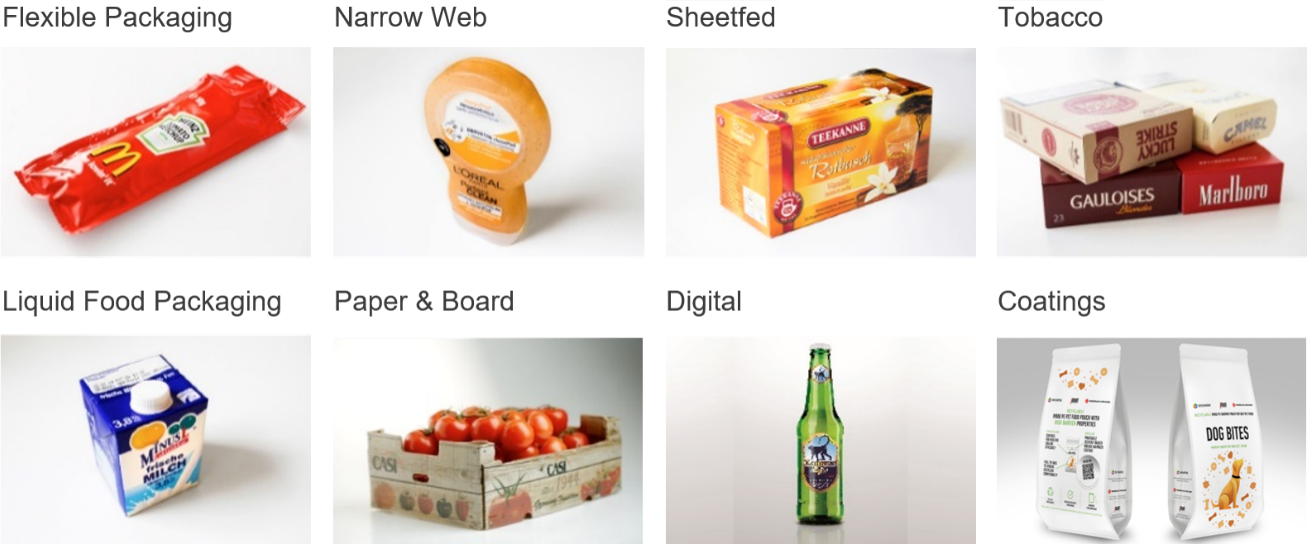
Figure 2: Siegwerk’s business units
Siegwerk continuously develops and introduces new products to create competitiveness, sustainability and regulatory compliance for its customers. A few developments for inks for the reporting year include the launch of:
- Nitrocellulose (NC)-free ink systems for flexible plastic packaging, preparing the market for upcoming limitations in the use of NC due to its negative effects on recycling and subsequent regulations (especially the Packaging and Packaging Waste Regulation (PPWR));
- expansion of low-migration ink systems such as our SICURA ink series for narrow web applications. These also support compliance with upcoming changes in the German Ink Ordinance (GIO);
- expansion of low migration ink systems such as our SICURA ink series for narrow web applications. These also support compliance comply with upcoming changes in the German Ink Ordinance (GIO); and
- dual-curing UV inks such as SICURA Nutriflex LEDTec or SICURA Flex Dual Cure allowing the use of either LED or UV mercury lamps.
In addition to its ink and varnish portfolio, Siegwerk has been focusing on functional coating technologies for various substrates and processes. A key example is the CIRKIT portfolio of functional barrier and other coatings designed to support the transition to circular packaging solutions, including applications for films and paper, and coatings providing barrier properties (e.g., oxygen, water vapor, oil & grease) and functional performance (e.g., heat-seal lacquer).
Further product development enabling sustainable packaging are presented in Chapters 7.4, 8.2 and 8.3.
In 2025 Siegwerk acquired Allinova. This acquisition added expertise in water‑based dispersions, wax emulsions and adhesives to Siegwerk’s portfolio – essential for the further development of circular packaging solutions.
While only responsible for together 4% of group revenues, Siegwerk also serves customers in the print media segment from its site in Siegburg, Germany and pursues sustainable packaging production through the Siegwerk ventures Packiro, based in Cologne, Germany.
Beyond physical products, Siegwerk provides relevant service offerings that support customer implementation and product stewardship. These include digital services (e.g., MyInkRoom, mySiegwerk Customer Portal, mySiegwerk Report Portal, Ink Safety Portal, INKonnect) and consulting services (e.g., on‑site consulting, in‑house support, color management, ink transition management).
3.2 Markets and Customer Groups Served
Section titled “3.2 Markets and Customer Groups Served”Siegwerk serves customers in more than 100 countries globally. It does so from more than 50 locations. Siegwerk is headquartered in Siegburg, Germany. Primary production is carried out in 15 Centers of Excellence. Proximity to customers is ensured through an additional network of 40 Blending Centers. Technology development is concentrated at 15 Centers of Competence.
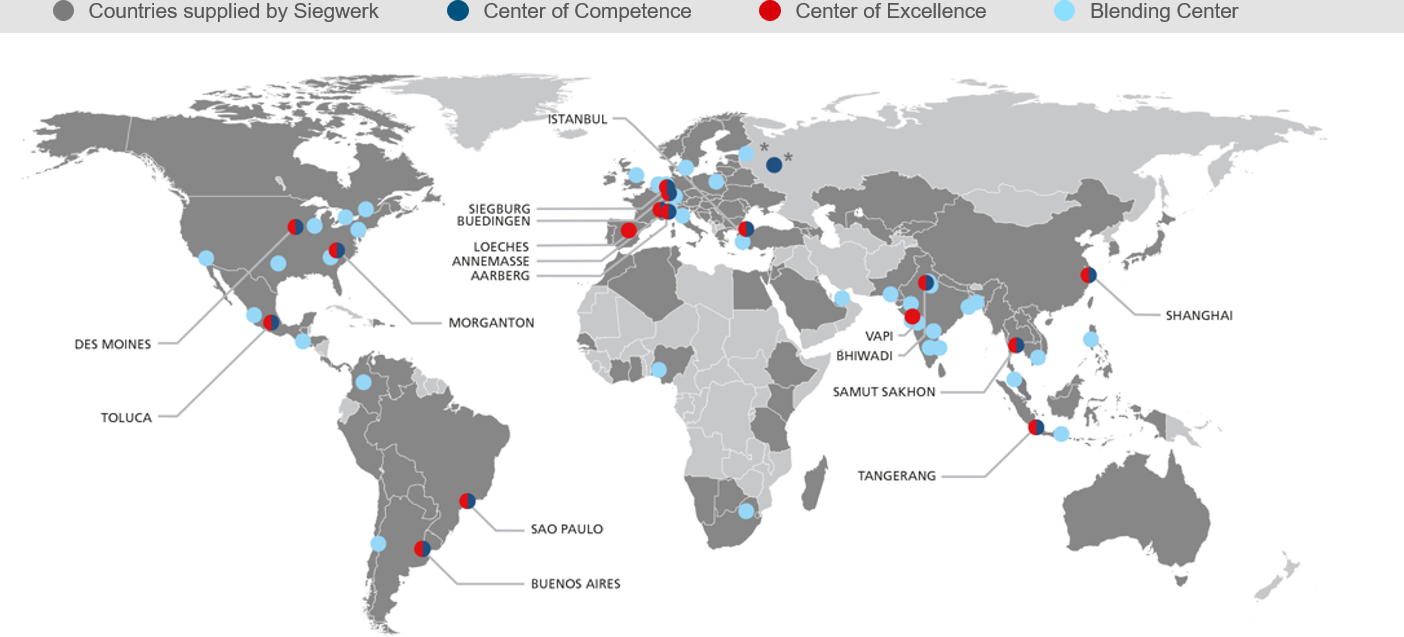
Figure 3: Siegwerk’s global footprint.
Customers include printers and converters and – by extension – brand owners and retail. For specific coating paper mills, film producers and dedicated coaters are part of the customer segment. Please refer to Chapter 4.1.2 for a more detailed value chain description.
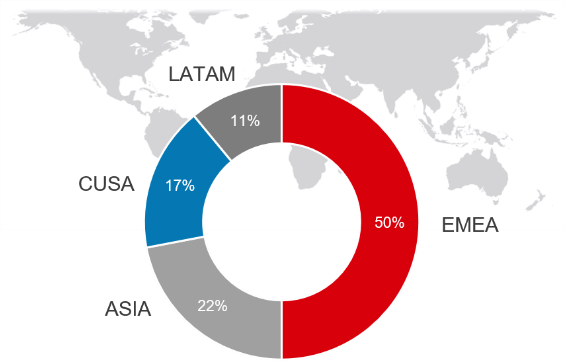
In the reporting year Siegwerk recorded 1,283 million EUR in revenue. Siegwerk’s global presence is reflected in the revenue split.
3.3 Sustainability Strategy
Section titled “3.3 Sustainability Strategy”This section describes Siegwerk’s sustainability strategy and its integration with the corporate strategy, in accordance with the applicable parts of ESRS 2 SBM-1 to SBM-3.
3.3.1 HorizonNOW: A Continuous Sustainability Journey
Section titled “3.3.1 HorizonNOW: A Continuous Sustainability Journey”Sustainability at Siegwerk is implemented as a continuous, multi-cycle strategic journey. HorizonNOW is the implementation framework for our sustainability strategy. Successive HorizonNOW cycles build on each other to ensure continuity, comparability and progressive enhancement of targets, metrics and governance.
HorizonNOW 2025 defined the material sustainability topics, targets and governance model for the period 2021–2025 and provides the framework for the performance reported for the financial year 2025. An overview of all HorizonNOW 2025 targets is displayed in Figure 5. It reflects the broader strategic transformation initiated in 2020, positioning Siegwerk as a circular and digital packaging solutions provider. For details on HorizonNOW 2025 please refer to the Sustainability Report 2025.
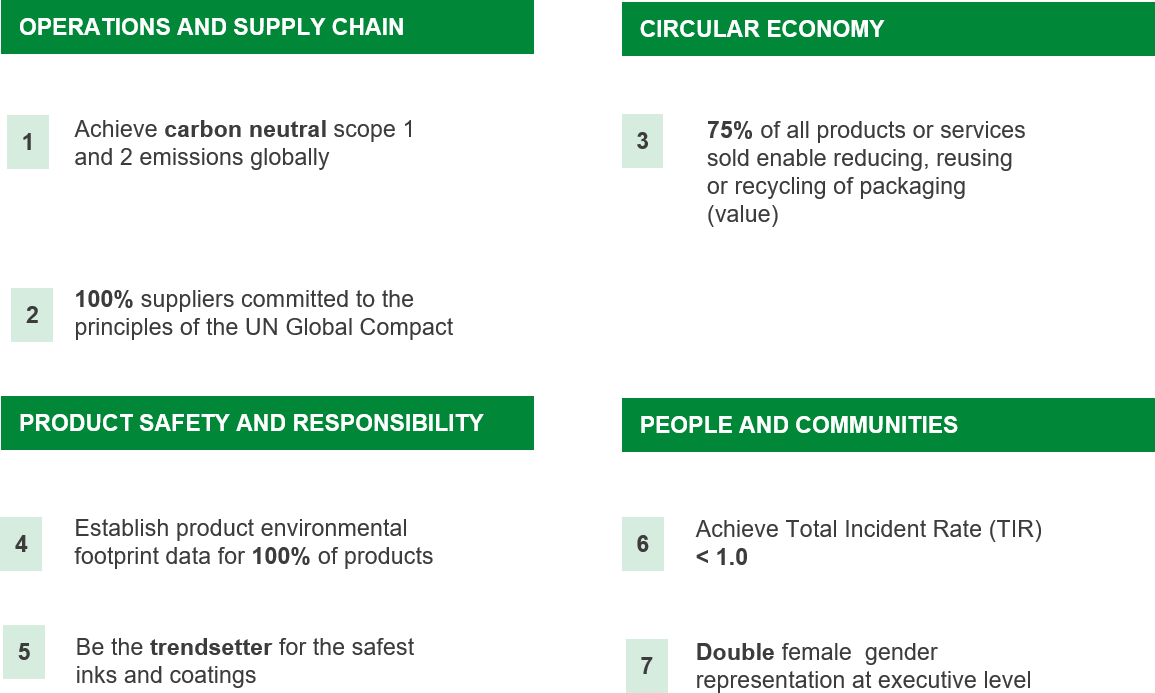
Figure 5: HorizonNOW 2025 targets
During 2025, management reviewed progress, market developments and material sustainability topics. Based on this review, the Global Executive Committee (GEC) approved HorizonNOW 2030 at the end of 2025 as the next strategic cycle, aligning sustainability with the corporate strategy Formula 2030 and reflecting it in the updated Sustainability Policy.
HorizonNOW 2030 ensures continuity of ambition while strengthening metrics, regional accountability and value chain coverage. Further details on HorizonNOW 2030 are provided in Chapter 3.3.3.
This sustainability report establishes clear linkages between retrospective and forward-looking information:
- 2025 performance is presented against the HorizonNOW 2025 framework; and
- HorizonNOW 2030 is introduced as the forward-looking strategic framework effective from 2026.
Where targets, metrics or methodologies differ between cycles, these changes are disclosed in the respective topical sections.
Targets were derived from a simple materiality assessment for the period 2020-2025 (HorizonNOW 2025) and a double materiality assessment as prescribed by ESRS for the periods of 2026 – 2030, as well as enriched by purely voluntary targets. Purely voluntary targets have been set to manifest values, cultural aspects, and basic operational foundations of the company.
3.3.2 Pairing Corporate and Sustainability Strategy: Formula 2030
Section titled “3.3.2 Pairing Corporate and Sustainability Strategy: Formula 2030”Formula 2030 is Siegwerk’s corporate strategy for 2026 - 2030, focused on accelerating profitable growth, strengthening competitiveness and doubling down on the strategic motives that have shaped the company’s development.
Formula 2030 is built on four strategic enablers: (1) competitiveness and excellence in the core business; (2) Team Siegwerk – developing the best team in the industry; (3) digitalization and AI readiness; and (4) sustainability. Sustainability is therefore not a standalone initiative but a core enabler of Formula 2030, supporting Siegwerk’s ambition to maintain a leading position in sustainability excellence while enabling converters, brand owners, substrate producers and regulators through expertise-based guidance.
Sustainability is embedded in Siegwerk’s long-term corporate strategy as a driver of competitiveness and long-term value creation. HorizonNOW 2030 is the group-wide sustainability program through which Formula 2030’s sustainability ambition is translated into measurable targets, governance and execution across the value chain.
Siegwerk’s purpose in sustainability remains unchanged: enabling sustainable packaging by integrating sustainability and competitiveness.
3.3.3 HorizonNOW 2030: Sustainable Packaging Enabled by Siegwerk
Section titled “3.3.3 HorizonNOW 2030: Sustainable Packaging Enabled by Siegwerk”HorizonNOW 2030 is structured in three strategic areas and operationalized through eight Group targets. HorizonNOW 2030 is further embedded in the Siegwerk Sustainability Policy (Version 3.0, May 2026), which sets out the overarching commitment to managing material impacts, risks and opportunities. In this chapter HorizonNOW 2030 will be introduced in more detail as a forward-looking part of our sustainability reporting covering ESRS 2 SBM-1 - SBM-3 as needed.
Strategic areas and value chain
Section titled “Strategic areas and value chain”HorizonNOW 2030 organizes sustainability across the full value chain in three strategic areas:
Sustainable procurement: driving sustainability in the upstream supply chain, with a focus on human and labor rights and climate action in purchased goods and services (Scope 3 Category 1). The explicit integration of upstream value chain sustainability is based on the conviction that sustainable products start with sustainable procurement.
Sustainable operations: minimizing environmental impacts of its own production while safeguarding employee health, safety and well-being; including decarbonization, renewable electricity, waste reduction, safety and diversity in leadership.
Sustainable products: enabling sustainable packaging through product innovation, regulatory expertise and value-chain collaboration; strengthening product trust and transparency through data-based product safety and the development of a sustainable product assessment.
Continuous improvement at site and entity level remains the backbone of delivery, complemented by global target management, regional execution through Regional Sustainability and coordination through Global Sustainability (see Chapter 3.4) for details.
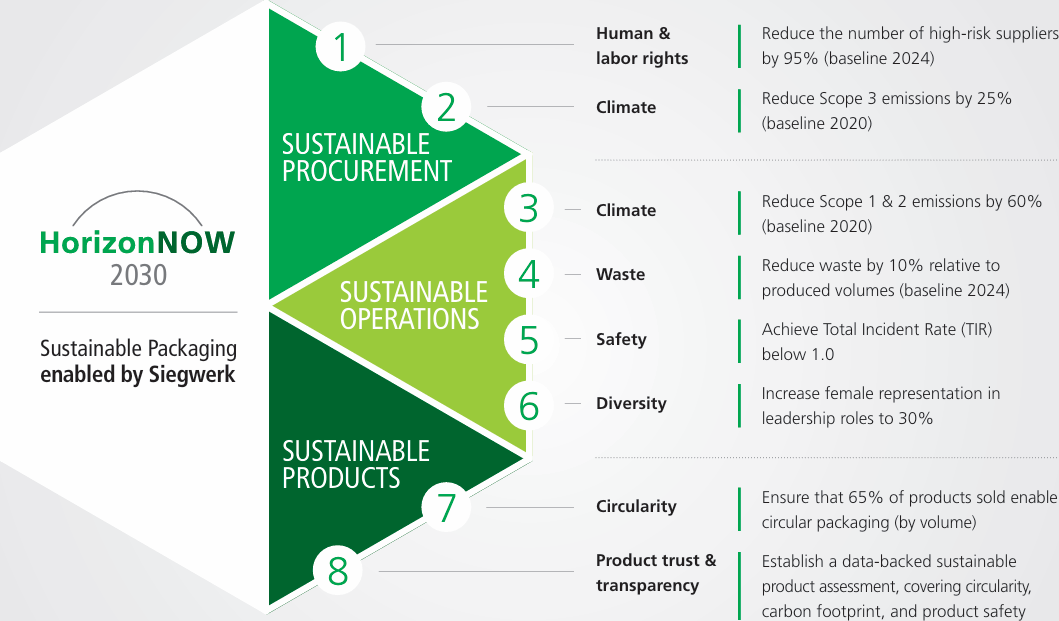
Figure 6: HorizonNOW 2030
With its holistic approach to sustainability Siegwerk contributes – within its realm of possibility – to the UN Sustainable Development Goals (SDGs) by translating globally aligned priorities into target-led contribution.
CONTRIBUTING TO THE UN SUSTAINABLE DEVELOPMENT GOALS
Siegwerk endorses the United Nations Sustainable Development Goals (SDGs) as a global reference for focusing sustainability action on material impacts and value-chain contribution. We do not claim to advance all 17 goals equally. Instead, HorizonNOW 2030 concentrates on a focused set of SDGs that match our double materiality outcome and the areas where our operations, products and supplier relationships can make a tangible difference.
Priority SDGs were selected where they correspond to material topics, support systemic rather than isolated change, and can be tracked through clear HorizonNOW key performance indicators across sustainable procurement, sustainable operations and sustainable products. On that basis, the relevant goals for Siegwerk are SDGs 3, 5, 7, 8, 11, 12 and 13.
How we address each priority SDG
Icon note: The SDG icons are used in line with United Nations SDG communications guidelines for non-UN entities. Further information: https://www.un.org/sustainabledevelopment. The content of this publication has not been approved by the United Nations and does not reflect the views of the United Nations or its officials or Member States.
HorizonNOW 2030 – Group targets
Section titled “HorizonNOW 2030 – Group targets”Actions and progress are measured across the three areas of impact through eight group wide targets. Targets are derived from material sub-topics identified through the DMA process or are voluntary commitments to manifest foundational ways of working and corporate culture, where considered necessary. Progress against these targets will be reported from financial year 2026 onwards unless otherwise stated in topical disclosures. Material impacts, risks and opportunities and their interaction with strategy, business model and financial planning are included in our DMA.
Strategic area | Theme | Group target | Target year | Baseline | Trigger for target setting |
|---|---|---|---|---|---|
Sustainable procurement | Human and labor rights | Reduce high-risk suppliers by 95% | 2030 | 2024 baseline | DMA |
Sustainable procurement | Climate – Scope 3 | Reduce Scope 3 emissions by 25% | 2030 | 2020 baseline | DMA |
Sustainable operations | Climate – Scope 1 and 2 | Reduce Scope 1 and 2 emissions by 60% Including: Operate on 100% renewable electricity year over year | 2030 | 2020 baseline | DMA |
Sustainable operations | Waste | Reduce waste by 10% relative to produced volumes | 2030 | 2024 baseline | Voluntary |
Sustainable operations | Health and safety | Sustain Total Incident Rate (TIR) < 1.0 | Ongoing | – | DMA |
Sustainable operations | Diversity | Increase female representation in leadership roles to 30% | 2030 | – | Voluntary |
Sustainable products | Circularity | 65% of products sold (by volume) enable circular packaging | 2030 | – | DMA |
Sustainable products | Sustainable products | Provide validated, data-backed sustainable product assessments | 2030 | - | Voluntary |
Table 4: HorizonNOW 2030 Group targets
Stakeholder interests and strategy
Section titled “Stakeholder interests and strategy”Siegwerk’s sustainability strategy reflects the interests and perspectives of its key stakeholders, including employees, suppliers and workers in the value chain, customers, local communities and investors. As a sixth-generation family-owned business, the long-term orientation of the owner family is an integral component of the strategic approach. This is reflected in the continued commitment to invest in the transformation of the business towards more sustainable solutions, with the aim of creating lasting value for current and future generations.
Stakeholder perspectives are systematically integrated into the strategy through the double materiality assessment (DMA), as well as through ongoing regional engagement processes, structured customer collaboration and continuous dialogue on regulatory developments. This includes a strong focus on advancing circular and sustainable packaging solutions, product safety and compliance. By incorporating stakeholder input into the identification and management of material impacts, risks and opportunities, the strategy aligns with ESRS requirements for transparent and decision-useful sustainability disclosures.
Further details on stakeholder engagement and how stakeholder views inform strategy and governance are provided in Chapter 13.4.5.
Financial implications and resource allocation
Section titled “Financial implications and resource allocation”As part of HorizonNOW, the company allocates significant financial resources to address material sustainability-related impacts, risks, and opportunities. These investments support the transition towards a more sustainable and resilient business model.
For HorizonNOW 2025 and the reporting year covered by this report, key initiatives include the following (selection):
- generation and purchasing of 100% renewable electricity for Siegwerk’s own operations (the latter mainly through RE 100 renewable electricity certificates) (ESRS E1):
- capital expenditure for investments reducing the amount of GHG emitted (ESRS E1), including projects with a longer than usual payback time to account for the strategic and forward-looking nature of investments;
- Human Rights Impact Assessment and Supplier Engagement program for pigment suppliers in India (ESRS S2); and
- research and development of new products enabling circular packaging such as NC-free ink series, extension of circular coating portfolio CIRKIT (ESRS E5).
For HorizonNOW 2030 the following investments are anticipated (selection):
- continue investments in always securing 100% renewable electricity by investing in own solar capacities, power purchasing agreements and renewable electricity certificates (ESRS E1);
- dedicated Green Fund for low- or no payback projects for carbon reduction (ESRS E1);
- investments in health and safety structural improvements (ESRS S1);
- supplier capability projects for high-risk topics (ESRS S3); and
- expansion of CIRKIT coatings portfolio (ESRS E5).
Thematic details on past and planned investments can be found in the relevant subject chapters. Where material, Siegwerk assesses the current and anticipated financial effects of sustainability-related risks and opportunities on its financial position, financial performance, and cash flows over the short-, medium-, and long-term horizons. This includes, for example, capital expenditures required for decarbonization and potential operational cost impacts from energy price developments. These considerations are aligned with the climate risk assessment.
3.4 Sustainability Governance
Section titled “3.4 Sustainability Governance”This section describes how sustainability is governed at Siegwerk in accordance with ESRS 2 General Disclosures (GOV-1 to GOV-4) and the governance principles in ESRS 1 (para. 56-59). It reflects the multilevel governance model set out in the Siegwerk Sustainability Policy, which combines global strategic steering with regional accountability.
Sustainability governance connects oversight by the Supervisory Board and the Group Executive Committee (Siegwerk’s Executive Board) with operational delivery through Global Sustainability and Regional Sustainability, supported by cross-functional collaboration across Legal, Human Resources, Health, Safety and Environment (HSE), Supply Chain Management (SCM) and Purchasing/Procurement – on global, regional and site level.
3.4.1 Role of Administrative, Management and Supervisory Board
Section titled “3.4.1 Role of Administrative, Management and Supervisory Board”Governance model
Section titled “Governance model”General structure
Sustainability at Siegwerk is governed through a structured, multilevel setup that combines global strategic steering with strong regional accountability, as illustrated in Figure 7.
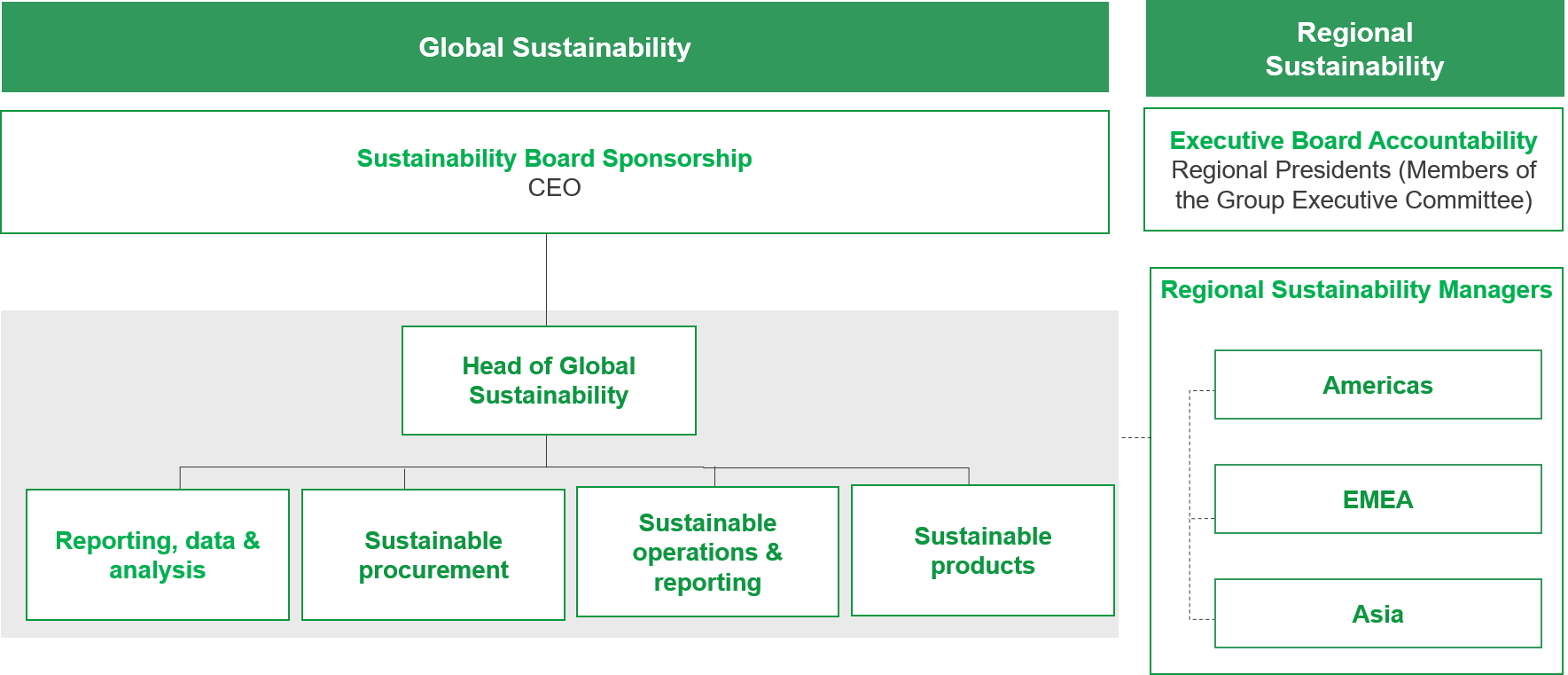
Figure 7: Sustainability governance structure
Board-level oversight and accountability
At Siegwerk the Group Executive Committee (GEC) forms the executive board. Overall accountability for sustainability lies with the Chief Executive Officer (CEO), Dr. Nicolas Wiedmann, ensuring alignment with company strategy and long-term targets under HorizonNOW 2030. He is the GEC sponsor. Further, board accountability is anchored regionally, with Regional Presidents (members of the Global Executive Committee) responsible for sustainability performance in their respective regions: Americas, EMEA and Asia. The Head of Global Sustainability presents progress on HorizonNOW 2030, the DMA, key sustainability risks and opportunities or required decisions to the on a per need basis – but typically every 3 months.
The supervisory board provides oversight of the GEC. It is informed on material sustainability topics through regular reporting cycles from the CEO (e.g. during supervisory board meetings) and the Head of Global Sustainability (e.g. for topic specific deep-dives).
Metric of the Group Executive Committee (GEC) (ESRS 2 GOV-1) | |
|---|---|
Number of members | 5 |
Independent members (%) | not applicable |
Female members (%) | 0% |
Male members (%) | 100% |
Gender diversity ratio (female:male) | 0:5 |
Employee representation on the board | not applicable |
Other aspects of diversity considered | Nationality |
Table 5: Composition of governance bodies (ESRS 2 GOV-1)
Global Sustainability – strategy, governance and oversight
Global Sustainability (GS) provides global guidance, governance and coordination across all sustainability topics and targets. Key responsibilities include governance and compliance, strategy and target management, data, systems and transparency, and global enablement and communication.
The Head of Global Sustainability leads Global Sustainability and is the central owner of sustainability governance and coordination. The Head of Global Sustainability also serves as Human Rights Officer. Global Sustainability comprises dedicated expertise in reporting, data and analysis, sustainable procurement, sustainable operations and sustainable products.
Regional Sustainability – execution and delivery
Regional Sustainability (RS) is responsible for execution and delivery of sustainability targets at regional level. Key responsibilities lie in operational sustainability and regional target achievement. Regional Sustainability Managers serve as the first point of contact for sustainability in the regions and ensure close linkage between regional execution and global governance. Together with the sites they are the team for local execution of the sustainability strategy.
Cross-functional integration
Sustainability governance integrates cross-functional collaboration with functions such as Legal, Human Resources, HSE, and Purchasing/Procurement, aligning regulatory expectations with company-wide standards. The Head of Global Sustainability is a member of the Compliance Circle (chaired by the CFO).
Responsibilities for oversight of material impacts, risks and opportunities
Oversight
Ultimate oversight responsibility is exercised by the CEO and the Head of Global Sustainability in a direct reporting line. Regional oversight at executive level is manifested through the Regional Presidents for their respective regions. The Regional Sustainability Managers are driving oversight operationally in their respective regions.
Global Sustainability is responsible for sustainability reporting, the DMA, stakeholder engagement, policy implementation and progress tracking against HorizonNOW 2030. Material topics are managed through the global–regional model and cross-functional collaboration described above.
Target setting and monitoring
Sustainability targets under HorizonNOW 2030 were developed by Global Sustainability together with functional experts and are implemented by various functions on the global, regional and site level (depending on the target). The Regional Sustainability managers monitor the progress and report the status to the Regional Presidents. The targets set have been approved by the GEC.
Target monitoring is supported by defined KPIs, internal performance reviews and, where applicable, external verification of selected metrics (see Chapter 12.4 ). Target monitoring systems are in place. These include a data collection hub with integrated quality and completeness controls as well as data output formats for easy reading of KPI data. The target monitoring systems fall within the responsibility of Global Sustainability.
Integration into strategy, major transactions and risk management
Material sustainability impacts, risks and opportunities are considered in strategic decision-making, including product portfolio development, major investments and acquisitions. For example, the acquisition of Allinova in 2025 was assessed from a strategic sustainability and innovation perspective. The know-how-driven acquisition enables Siegwerk to expand its circular economy coating offering (see Chapter 2.2.2).
Trade-offs between sustainability objectives and other business priorities are discussed at management and board level where material, for example in decisions relating to raw material choices, energy use, supplier selection and product reformulation.
Siegwerk does not have incentive schemes for members of the administrative, management and executive bodies that are linked to sustainability topics (ESRS 2 GOV-2).
Policy governance
The Siegwerk Sustainability Policy sets out the overarching commitment to managing material impacts, risks and opportunities across operations and the value chain. Regular reviews of the policy are carried out by Global Sustainability. Reviews are additionally triggered by material changes in the business model (such as acquisitions or divestments) or updates to the sustainability strategy.
Sustainability expertise and skills
Section titled “Sustainability expertise and skills”Sustainability-related expertise is available to governance bodies through Global Sustainability, Regional Sustainability and selected external advisors where needed. Relevant expertise covers climate and energy, circular economy, human rights and labor standards, and sustainability reporting. Training and access to expertise for board, management and employees are provided directly by Global and Regional Sustainability or training offered.
3.4.2 Statement on Due Diligence
Section titled “3.4.2 Statement on Due Diligence”Siegwerk applies a due diligence approach aligned with the ESRS 1 concept of due diligence as an ongoing process to identify, prevent, mitigate, stop, minimize and remediate actual and potential negative impacts on people and the environment connected with its business.
To strengthen human and labor rights in its own operations and the supply chain, Siegwerk has established Guiding Principles on Human Rights and a global human rights management system compliant with the German Supply Chain Due Diligence Act (Lieferkettensorgfaltspflichtengesetz, LkSG) and the anticipated requirements of the EU Corporate Sustainability Due Diligence Directive (CSDDD). The management system covers its own operations and suppliers with the aim to identify, prevent and remediate environmental and human rights risks.
An optionally anonymous grievance mechanism is accessible to affected stakeholders in own operations and at suppliers: https://siegwerk.integrityline.app/.
The outcome of due diligence informs the DMA and the identification of material impacts, risks and opportunities. Governance bodies oversee due diligence through the CEO, Regional Presidents and Global Sustainability.
Siegwerk regularly reviews its double materiality analysis to identify emerging impacts, risks and opportunities and develops metrics, policies and measures as needed. The sustainability agenda integrates the perspectives of affected stakeholders, including own workforce, suppliers and workers in the value chain, customers and communities.
In line with ESRS 1, governance of sustainability reporting is closely linked to the DMA. The undertaking Siegwerk performs its materiality assessment for the consolidated Group and uses the outcomes to determine the scope of disclosures in this statement.
Stakeholder engagement outcomes are consolidated by Global Sustainability and discussed with Regional Sustainability and the Group Executive Committee (GEC). Further details on stakeholder engagement are provided in Chapter 13.4.5.
The table below cross-references the main steps of the due diligence process to the relevant sections of this sustainability statement.
Due diligence step (ESRS 1) | Location in this report | Primary ESRS reference |
|---|---|---|
Embedding due diligence in governance and culture | GOV-1, GOV-3 | |
Engaging with affected stakeholders | ESRS 1 Ch. 4; IRO-1 | |
Identifying and assessing impacts | IRO-1, IRO-2 | |
Taking action to address impacts | GDR-A across ESRS | |
Tracking effectiveness of actions | GDR-M, GDR-T | |
Providing for or cooperating in remediation | S1/S2 grievance mechanisms | |
Materiality assessment and reporting scoping | Chapter 4 (Double Materiality Assessment) | ESRS 1 Ch. 3 |
Table 6: Mapping of due diligence steps to report sections
3.4.3 Risk Management and Internal Controls Over Sustainability Reporting
Section titled “3.4.3 Risk Management and Internal Controls Over Sustainability Reporting”Siegwerk has established processes to support the completeness, accuracy and consistency of sustainability information reported in this statement.
The internal control environment for sustainability reporting covers data collection, validation, consolidation, review and approval of disclosures for material topics within the reporting boundary described in Chapter 2.2.
Main features and components of the internal control environment include:
Governance: Global Sustainability coordinates reporting; Regional Sustainability Managers and functional data owners provide regional and topic-specific data; senior management and the GEC review consolidated disclosures.
Data controls: Site and functional data owners are responsible for source data quality. Data is validated through a system-based approach in a first step. The data entry and consolidated reporting tool in use check for completeness and potential data entry errors. In a second step, Global Sustainability validates the entries based on a mix of randomized data checks and known patterns of increased scrutiny.
Methodology controls: Reporting methodologies and assumptions are documented for key metrics (e.g. GHG inventory, workforce data, pollution metrics). Changes in methodology are reviewed and disclosed where material.
DMA controls: The DMA is owned by Global Sustainability while being subject to internal expert review and management validation. See Chapter 4 for details.
Policy controls: The Sustainability Policy and related topic policies (e.g. Human Rights Guiding Principles, Code of Ethical Business Conduct) provide the control framework for sustainability expectations across the Group.
Limitations: This sustainability statement has not been subject to independent third-party assurance.
No material control gaps have been identified in the reporting period.