
10 Workers in the Value Chain (ESRS S2)
ESRS Ref: ESRS S2 Workers in the Value Chain / Sub-topic: Other labor-related human rights (child labor; forced labor)
ESRS cross-references: ESRS E1 Climate Change; ESRS E2 Pollution; ESRS S1 Own Workforce; ESRS S3 Affected Communities
HorizonNOW 2030: Sustainable procurement, target 1
10.1 Relevance of Topic
Section titled “10.1 Relevance of Topic”Child labor and forced labor are material for Siegwerk as potential negative human rights impacts in our upstream value chain. Both sub-topics were identified as material through the human rights override in our double materiality assessment. Under ESRS 1, for potential negative human rights impacts, the severity of the impact takes precedence over its likelihood. The materiality conclusion therefore reflects the severity of potential impacts on affected people, even where score-based impact materiality alone would not have triggered disclosure, and even where financial materiality is not triggered in Siegwerk’s own operations.
ESRS S2 covers workers in Siegwerk’s upstream and downstream value chain who are not part of the its own workforce. This includes, among others, workers of suppliers who work on the supplier’s premises using the supplier’s work methods, and workers deeper in the supply chain who extract commodities that are subsequently processed into components used in the undertaking’s products. For Siegwerk, the material impacts under this chapter arise in the upstream value chain linked especially to raw materials for inks and coatings. Downstream value-chain workers are not the focus of the material IROs assessed for child labor and forced labor.
Siegwerk’s ink and coating value chain depends on raw materials linked to sectors with elevated inherent human rights risk, notably agriculture, oil and gas, and mining. Child labor is particularly associated with agricultural production; forced labor and modern slavery risks are documented across oil and gas, mining and agriculture. These risks usually do not arise at our direct (tier 1) suppliers. They may occur further upstream at tier n stages - for example in feedstock extraction, farming, mining or subcontracted services - where visibility and leverage are more limited. The related impacts are therefore primarily upstream and often beyond tier 1. Our influence is exercised mainly through expectations, risk screening and engagement with direct suppliers, who in turn must manage their own upstream relationships.
10.2 Metrics and Targets
Section titled “10.2 Metrics and Targets”ESRS S2 does not prescribe a fixed set of quantitative own-operations-style metrics comparable to ESRS S1 workforce tables. Siegwerk therefore reports entity-specific procurement metrics that track the effectiveness of its upstream due diligence, rather than site-level headcount data for workers at supplier facilities that it does not control.
Metrics and targets for workers in the value chain need to be differentiated between the last strategy cycle HorizonNOW 2025 – against which progress is reported – and the new strategy cycle HorizonNOW 20230 which provides an outlook (see Table 23). In this case the differentiation is also an indicator of the increasing maturity of the topic, by improving metrics as well as setting up solid implementation frameworks, most notably the supplier sustainability program SustainUP.
Target5 | Target year | Strategic cycles | Progress/outlook reporting |
|---|---|---|---|
100% of Siegwerk’s suppliers commit to the ten principles of the United Nations Global Compact (UNGC) | 2025 | HorizonNOW 2025 | Progress |
Reduce high-risk suppliers by 95% against a 2024 baseline | 2030 | HorizonNOW 2030 | Outlook |
Table 23: Targets for workers in the value chain
10.2.1 HorizonNOW 2025 Metrics and Targets
Section titled “10.2.1 HorizonNOW 2025 Metrics and Targets”Under HorizonNOW 2025, the group target was that 100% of Siegwerk’s suppliers commit to the ten principles of the United Nations Global Compact (UNGC), which address human rights, labor, environment and anti-corruption. Suppliers in scope included all recurring suppliers with a minimum annual purchasing value of 100T€. Suppliers excluded from the scope are considered to have a negligible impact.
The metric measured the percentage of suppliers with a documented commitment to these principles. Siegwerk did not require formal UNGC membership. Commitment was evidenced through written confirmation and, over time, embedded in the supplier onboarding process, following an initial phase of manual outreach and documentation. Progress data were reviewed annually by an external third party as part of verification supporting an ESG-linked loan.
The UNGC principles were selected because they provide a broadly recognized framework covering the spectrum of environmental, human rights and integrity expectations relevant to our supply chain. For customers, supplier commitments also supported supply-chain standard security and readiness for stricter due diligence expectations, including requirements under German and European supply-chain legislation. The target path rose from 70% (2021–2022) to 80% (2023), 90% (2024) and 100% (2025).
10.2.2 HorizonNOW 2030 Metrics and Targets
Section titled “10.2.2 HorizonNOW 2030 Metrics and Targets”Having secured broad baseline commitment to the UNGC principles, Siegwerk shifted from a uniform commitment metric to a risk-differentiated approach. A written commitment alone does not differentiate suppliers according to the severity of residual human rights or environmental risk. HorizonNOW 2030 therefore introduces a target to reduce high-risk suppliers by 95% by 2030 against a 2024 baseline, measured through risk scoring based on EcoVadis IQ.
Figure 31shows the risk profile of all suppliers based on an abstract risk analysis6. However, raw material and packaging suppliers concentrate risk. The risk profile of those suppliers, which function as our baseline is seen in Figure 34. The baseline of high and very high-risk suppliers is 49% - based on abstract risk analysis and where available specific risk assessment. The baseline year is 2024. As with the previous target, annual achievement rates are defined.
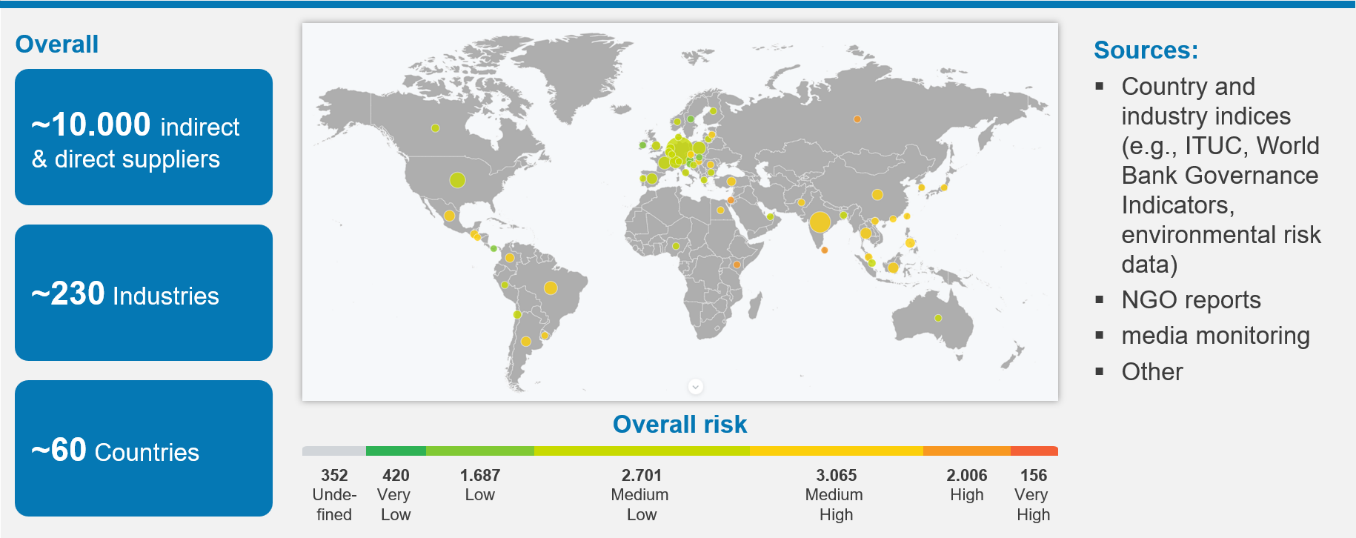
Figure 31: Abstract risk analysis of all Siegwerk suppliers
For this purpose, a supplier is classified as high risk if the EcoVadis overall score is below 25 out of 100, or if the score in any of the four EcoVadis themes Environment, Labor & Human Rights, Ethics, and Sustainable Procurement is below 25 out of 100 (see Figure 32. Those theme scores reflect underlying management-system elements (policies, targets and measures). The metric therefore directs purchasing and sustainability resources to suppliers with the weakest demonstrated sustainability management, including on labor and human rights, and supports escalation, development or, where necessary, commercial consequences under SustainUP (see Chapter 12.1). The different categories in the assessment of risk underline the increasing scope of supplier engagement.
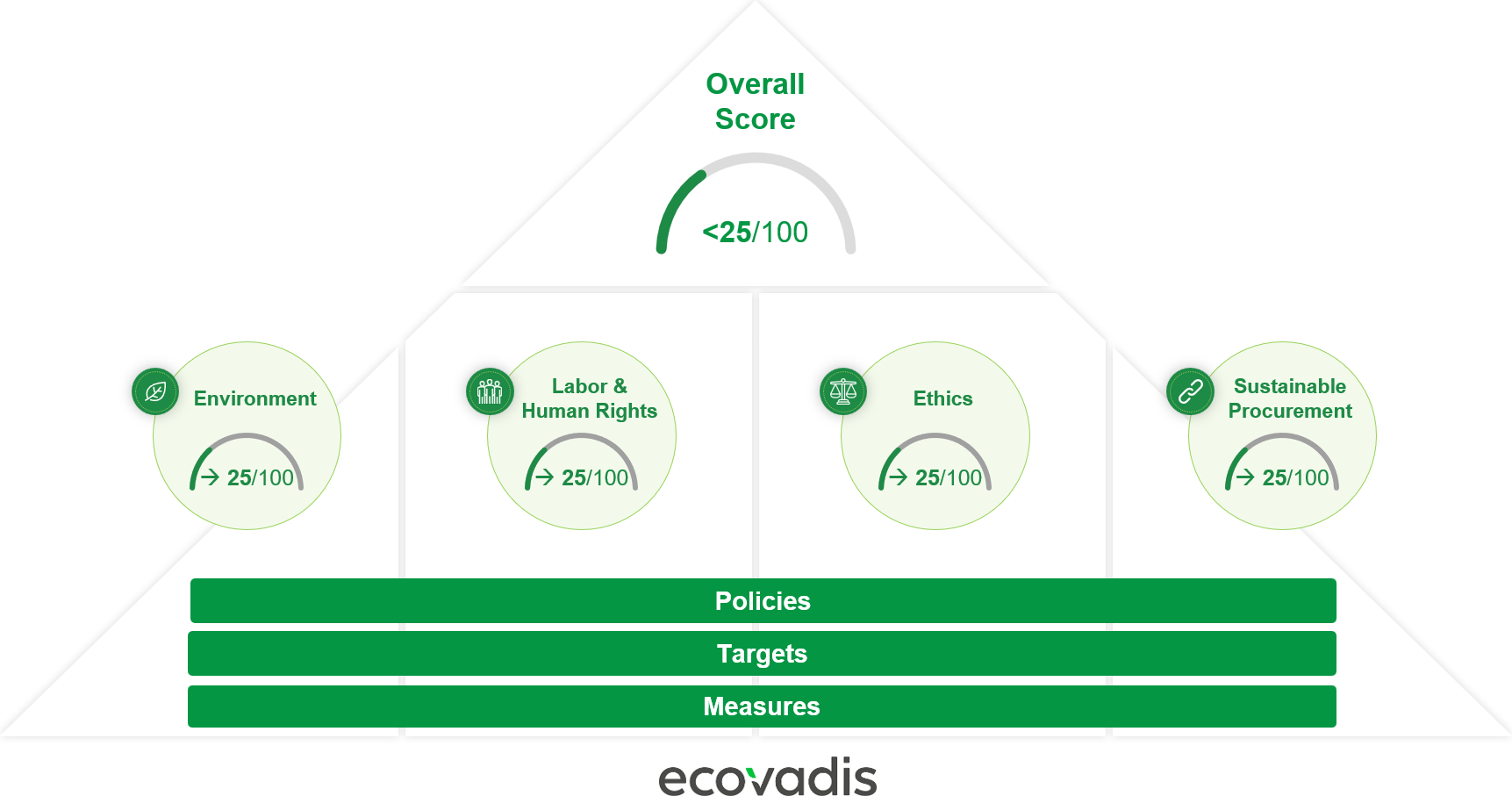
Figure 32: Supplier risk scoring method
10.3 Policies & Governance
Section titled “10.3 Policies & Governance”Siegwerk has published a Human Rights Policy, including Human Rights Guiding Principles, which sets out the commitment of ownership, management and employees to respect human rights and to address risks in the supply chain through a forward-looking, collaborative approach with business partners. The Business Partner Code of Conduct defines expectations toward suppliers and other partners and encourages them to identify human rights and environmental risks in their own operations and upstream supply chains. It is accompanied by a Siegwerk Sustainability Checklist used to analyze the status and initiate improvements jointly. Both the Code of Conduct and the Checklist form part of the supplier onboarding process.
Suppliers are the primary gateway to safeguarding workers’ rights in our upstream value chain. Governance is therefore twofold: Purchasing acts as the central interface to suppliers. The Global Purchasing team operationalizes the oversight and support of suppliers, by e.g. sending out rating requests and following up with suppliers, identifying potential risks during ongoing supplier visits, and following up on development plans where needed. Global Sustainability and the Human Rights Officer guide Purchasing on required actions, risk prioritization and escalation. Furthermore, Global Sustainability is responsible for policies, related internal training, strategic supplier engagement programs and larger scale supplier trainings. Global Sustainability is also responsible for the supplier engagement program SustainUP, described in more detail in Chapter 12.1.
As human and labor rights in the supply chain are increasingly becoming a regulatory topic as well, the Human Rights Officer is responsible for ensuring legal compliance with applicable standards, such as the German Supply Chain Due Diligence Act (“Lieferkettensorgfaltspflichtengesetz”). This includes the implementation and maintenance of required systems as well as continued screening and readiness checks for upcoming regulations.
10.4 Actions
Section titled “10.4 Actions”10.4.1 General Approach
Section titled “10.4.1 General Approach”Actions have matured across strategy cycles. Under HorizonNOW 2025, the first step was to build a common baseline of understanding by securing supplier commitment to the UNGC principles, gathering supplier information and supporting partners who struggled to interpret those principles. During the HorizonNOW 2025 strategy cycle, supplier education on the UNGC principles required more time than initially expected, despite the well-established framework. This showed how nascent the topics of human rights in the supply chain were at that time. To ease the process, suppliers were categorized, starting with the largest suppliers. Commitment was subsequently integrated into the supplier qualification process, ensuring that new suppliers commit to the UNGC principles from the beginning.
HorizonNOW 2030 builds on that foundation through SustainUP - a holistic supplier sustainability program that combines risk-based screening, dialogue, capability building and escalation. The program design started in 2024 and was officially launched in 2025. Hence, even though we were still focusing on maintaining and working towards our target of having 100% of suppliers committed to the UNGC Guiding Principles, the foundational work for the maturing of supplier engagement was already in progress in 2025. While Siegwerk deliberately took a decision to go beyond legal compliance on human and labor rights in the supply chain, the setting up of SustainUP also functions as the framework for legal compliance with the German Supply Chain Due Diligence Act (“Lieferkettensorgfaltspflichtengesetz”).
All details on SustainUP are covered in Chapter 12.1. Adjacent to SustainUP, Siegwerk conducts systemic deep dives into high-risk topics through human rights impact assessments and supplier capability programs, illustrated below for the reporting period.
10.4.2 Practical Case Studies from Reporting Year
Section titled “10.4.2 Practical Case Studies from Reporting Year”Human Rights Impact Assessment – Pigments, India
Section titled “Human Rights Impact Assessment – Pigments, India”As part of its human rights due diligence under SustainUP, and in line with ESRS S2, Siegwerk conducted a Human Rights Impact Assessment (HRIA) of selected pigment suppliers in India in 2023/2024. The assessment covered six India-based pigment suppliers for green and blue pigments - a high-risk raw-material segment for printing inks - and combined desktop research and NGO interviews with factory tours and worker interviews. The aim was to enhance abstract risk assessments with on-the-ground evidence, identify actual and potential adverse impacts on people consistent with the UN Guiding Principles on Business and Human Rights, and define individual improvement plans, includingfollow-up measures.
Priority findings included the heightened vulnerability of contract workers and security guards to labor-related human rights impacts, including risks related to wages, working hours, leave and benefits, recruitment practices and limited channels for raising concerns. Medium-priority issues included inconsistent occupational health and safety and environmental controls, as well as heat stress. Several challenges are endemic to the industry and may arise not only at direct (tier 1) suppliers, but also through third-party labor agencies used by suppliers and deeper tier-n stages of the value chain.
India Supplier Engagement Program
Section titled “India Supplier Engagement Program”Based on the initial HRIA results a prioritization workshop held with value-chain partners identified endemic topics for concrete improvement. Priority was given to grievance mechanisms as an overarching enabler, living wage and overtime, as well as health and safety. In response, Siegwerk launched an India Supplier Engagement Program under SustainUP. The program translated HRIA findings into practical ambition:
- scaling impact beyond the six assessed suppliers;
- supporting suppliers, particularly SMEs, to meet heightened expectations;
- building awareness on grievance redressal, living wages and overtime, and health, safety and environment;
- enabling suppliers to identify gaps and define improvement measures with follow-up by local purchasing teams; and
- strengthening Siegwerk’s own capability for on-the-ground supplier engagement.
During 2025, activities included four webinars on business and human rights, grievance redressal mechanisms, health, safety and environment, and living wages and overtime, with around 80 supplier participants across the webinar series, followed by a three-day in-person workshop in Mumbai with around 45 suppliers. Suppliers subsequently worked on self-identified improvement measures, with progress check-ins conducted by purchasing colleagues. The program is designed to conclude with a Supplier Sustainability Conclave in Delhi in November 2026, bringing together suppliers, Siegwerk representatives from Global Sustainability and Purchasing, and external experts for practical exchange on business and human rights and carbon reduction, including supplier recognition for leading practice. This sequence, moving from impact assessment (ESRS S2), to supplier engagement and actions (ESRS 2 GDR-A / S2 actions), to industry-level dialogue, strengthens the prevention and mitigation of value-chain human rights impacts in India.
10.5 Progress & Outlook
Section titled “10.5 Progress & Outlook”10.5.1 Progress
Section titled “10.5.1 Progress”The HorizonNOW 2025 target of 100% of suppliers committed to the principles of the UNGC was achieved in 2024 and maintained throughout the reporting year (see Figure 33).
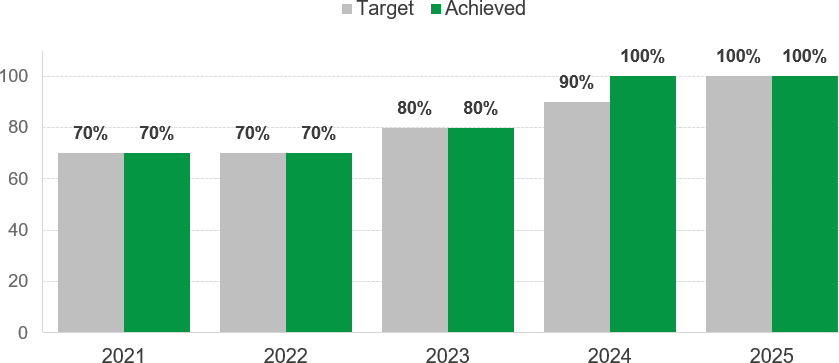
Figure 33: Commitment to the principles of UNGC - Target achievement development
Although the HorizonNOW 2030 target of reducing high-risk suppliers by 95% is not part of the formal reporting scope of this report, a quick preview is provided, revealing continued progress in driving the topic of human and labor rights in the supply chain.
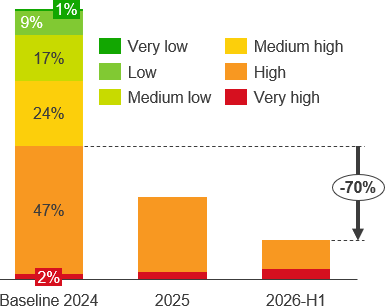
Within the first year of the launch of SustainUP, high-risk suppliers have already been reduced by 70%. Among other factors, this reflects efforts to replace abstract risk assessments (which consider only country and industry risk) with individual supplier risk assessments based on the EcoVadis methodology described above.
Furthermore, in March 2026, EcoVadis awarded Siegwerk the 2026 Sustainability Achievement Award in the category “Best New Program” for SustainUP. The award recognizes rapid progress in establishing a human rights-oriented sustainable procurement program within the early years of the EcoVadis journey, with particular emphasis on transparency, early impact and systematic focus on human rights in the global supply chain. In addition, the Sustainability Heroes Award by DQS nominated the SustainUP program in its category “Social Impact”.
10.5.2 Outlook
Section titled “10.5.2 Outlook”Looking ahead, three interconnected workstreams will shape the next phase of our response to material human rights impacts in the upstream value chain.
First, we will complete the supplier capability-building program in India with the Supplier Sustainability Conclave planned for November 2026 in Delhi. The conclave will bring together participating suppliers to review progress, consolidate improvement actions identified through the program, and recognize leading practices that can support broader uptake of responsible business conduct across the supply base.
Second, building on the experience and outcomes of the India program, we intend to replicate the capability-building approach in another high-risk sourcing cluster. The selection of the next focus area will be informed by inherent human rights risk, the potential severity of impacts, and our ability to drive meaningful improvements in collaboration with suppliers and other relevant stakeholders. Topic selection is planned for 2026, with implementation commencing in 2027.
Third, we will continue to advance the implementation of our HorizonNOW 2030 commitments through enhanced supplier due diligence. This includes conducting more granular risk assessments for suppliers identified as high risk, agreeing on supplier development plans where improvement opportunities exist, and applying graduated escalation measures where suppliers do not demonstrate progress against core sustainability expectations over time.
Footnotes
Section titled “Footnotes”Not based on identified materiality during the DMA. ↑
Figures are regularly updated based on number of new suppliers and re-evaluation through external sources, status summer 2026, abstract risk. ↑